Buying Guides
OEM POS Terminal vs Off-the-Shelf: Which Is Better for System Integrators?
Buying off-the-shelf or going OEM for your next POS rollout? Compare MOQ, customization, certification, lead time and long-term supply — and see which fits your project.
If you are a system integrator, every POS rollout starts with the same question: buy an off-the-shelf terminal and ship it, or work with an OEM/ODM manufacturer and have the hardware built to your spec?
There is no universally right answer. Off-the-shelf is faster. OEM is more flexible. The wrong choice shows up later — in a terminal that cannot take your client's peripheral, a certification your market requires but the unit does not carry, or a model that disappears from the market halfway through a multi-site rollout.
This guide compares the two routes on the six factors that actually decide a project: order quantity, customization, certification, lead time and long-term supply and total cost. It ends with a simple rule for choosing.
1. Order quantity: how many units makes OEM worth it?
Off-the-shelf terminals are built for single-unit and small-batch buyers. You can order ten units today and ten more next quarter, usually from stock.
OEM/ODM manufacturing is built around a production run. The factory sets up tooling, firmware and packaging for your configuration, so it needs a minimum order quantity (MOQ) to make that setup worthwhile. Below that volume, the setup cost outweighs the unit saving.
Rule of thumb: if your project is a handful of units for one site, buy off the shelf. If you are rolling out the same configuration across dozens or hundreds of sites, get an OEM quote — the per-unit price at volume is usually where the saving appears.
2. Customization: branding, hardware and software
This is where the two routes diverge most.
An off-the-shelf terminal arrives as the manufacturer designed it: fixed screen size, fixed ports, fixed branding. You can usually add your software, but you cannot change the bezel, add a customer-facing display, or remove a logo your client does not want.
An OEM/ODM terminal is built to your spec. Typical customization includes your branding on the housing and boot screen, screen size and mounting options, extra ports for peripherals such as barcode scanners, receipt printers and cash drawers, and pre-installed firmware or software images so units arrive deployment-ready.
If your client needs the terminal to look and behave like their own product, OEM is the only route that delivers it. If the standard unit already fits, customization is cost you do not need.
3. Certification: the requirement that kills projects late
Certification is the most commonly underestimated factor. A terminal that works in a lab can still be unusable in your market if it lacks the required marks.
Before choosing, confirm which certifications your deployment market requires — for example CE and RoHS in Europe, FCC in the United States, and BIS for India — and confirm them in writing for the exact model and configuration you will receive, not for a similar model. A configuration change, such as a different power supply or wireless module, can invalidate a certificate.
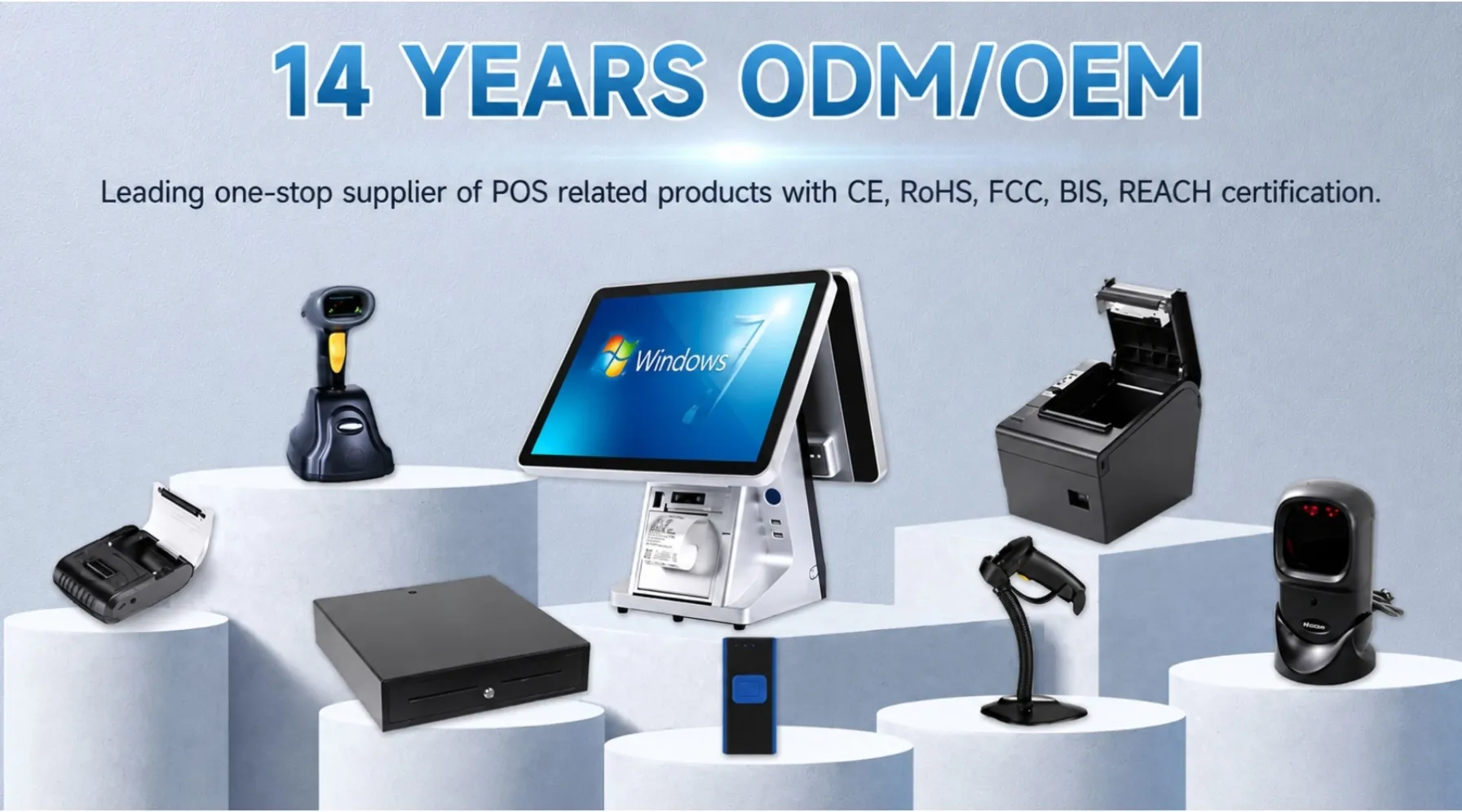
GHI's hardware carries CE, RoHS, FCC, BIS and REACH certification. Whatever supplier you choose, ask for the certificate documents before you commit, and check the model number on the certificate matches the model number on your order.
4. Lead time: speed vs control
Off-the-shelf wins on speed: stock units can ship in days.
OEM takes longer. Tooling, samples, certification checks and a first production run all add weeks before the first shipment. Plan for a sample-and-approval cycle: approve a physical sample before the full run starts, and build that time into your project plan.
If your client needs hardware next week, OEM is not an option. If the rollout is phased over months, the OEM lead time usually fits inside the project timeline — and the sample cycle is what protects you from receiving hundreds of units with the wrong port layout.
5. Long-term supply: will the same model exist in two years?
Multi-site rollouts live or die on supply continuity. An off-the-shelf model can be discontinued or revised without notice; the replacement may look the same but carry a different mainboard, and your software image may no longer fit.
With an OEM partner, agree on supply continuity up front: how long the model will be produced, how component changes will be communicated, and what happens when a part reaches end of life. A manufacturer that has supplied the same product line for years — GHI has manufactured POS hardware since 2010 — is a better bet for a rollout that will still be expanding in year two or three.
6. Total cost: unit price is not the project price
Compare the full cost, not the headline unit price:
- Unit price: off-the-shelf — higher at volume; OEM/ODM — lower at volume.
- Setup and tooling: off-the-shelf — none; OEM/ODM — one-off, spread across the run.
- Customization: off-the-shelf — limited, often via third parties; OEM/ODM — built in.
- Integration labour: off-the-shelf — higher, adapting standard hardware; OEM/ODM — lower, units arrive configured.
- Spares and support: off-the-shelf — depends on the seller; OEM/ODM — agreed with the factory.
- Re-order risk: off-the-shelf — model may change or disappear; OEM/ODM — continuity agreed up front.
A cheap unit that needs hours of adaptation per site is not cheap. Price the whole deployment.
Decision table: which route fits your project?
- Fewer than 20 units, one site, standard setup — Off-the-shelf
- Same configuration across many sites — OEM/ODM
- Client branding or custom housing required — OEM/ODM
- Extra ports, displays or peripherals required — OEM/ODM
- Hardware needed within days — Off-the-shelf
- Rollout phased over months, sample approval possible — OEM/ODM
- Strict certification requirements in your market — Either — but verify certificates for the exact model
- Long-term supply continuity matters — OEM/ODM, with continuity agreed in writing
What to ask any OEM manufacturer before you commit
- What is the MOQ for this configuration, and what changes if the volume doubles?
- Which certifications does this exact model carry, and can you share the certificates?
- Can I approve a physical sample before the production run?
- How long will this model stay in production, and how will you notify me of component changes?
- What is included — firmware image, packaging, spares — and what costs extra?
The short answer
Buy off the shelf when the project is small, standard and urgent. Go OEM when the project is large, repeated or branded — and when the cost of the wrong hardware, discovered after deployment, is higher than the cost of doing it properly the first time.
If your project falls in the second group, talk to the manufacturer early, before the client has locked the specification. An OEM/ODM POS terminal manufacturer such as GHI can review your requirements — touch screen POS terminals, self-service kiosks, barcode scanners, thermal printers, cash drawers and time attendance hardware — and tell you honestly whether OEM will save you money on your volume, or whether off-the-shelf is the better call.
FAQ
Is an OEM POS terminal cheaper than an off-the-shelf terminal?
At volume, usually yes — the per-unit price falls as the production run grows. At small quantities, the setup cost makes OEM more expensive. Get a quote at your actual volume before deciding.
What is the difference between OEM and ODM for POS terminals?
OEM means the factory builds to your design and specification. ODM means the factory offers its own existing design, which you brand and
configure. Many POS hardware manufacturers, including GHI, offer both.
What MOQ should a system integrator expect for OEM POS terminals?
It depends on the configuration — standard branding changes need a smaller run than a custom housing or mainboard change. Ask the manufacturer for the MOQ at your exact specification rather than a generic number.
Do OEM POS terminals come with CE, FCC and RoHS certification?
They can, but certification belongs to a specific model and configuration. Always confirm the certificates cover the exact model you are ordering.
How long does OEM POS terminal production take?
Longer than buying stock — allow time for samples, approval and the first production run. If your deadline is days away, buy off the shelf; if your rollout is phased over months, OEM lead time usually fits.